I’m currently working on a project that uses Easy Data Transform to convert shop order exports into Post CSV format. I’m making progress, but I realize that a short crash course from someone experienced with EDT would save me a lot of time.
I’m looking for 1–2 hours of online tutoring from someone who really knows Easy Data Transform and can walk me through a few workflow questions specific to my use case.
What I’m offering:
Paid session at $25/hour
1–2 hours max
I’ll provide sample files and explain exactly what I need before the call to keep things efficient.
If anyone here is interested or can recommend someone please let me know.
I would really appreciate the help!
I think here are some people (including myself) which like to do some finger exercise. If it is not confidential I suggest you describe your challenge here (source layout and what you want to archieve). Typically you get ideas and solutions. It might help in general other users, too.
I don’t know that you will get many takers at $25 per hour. However, as Olaf says, you post the issue you re having here and you might get a free solution. Ideally post a simple example input and the corresponding output you want.
Take 2 hours to read through the pdf and you get an overview what is possible and search selective when you have special needs. I know reading documentation is old fashioned, but very helpful. And the documentation is updated with each release.
Search in the forum is powerful, too and might give you a lot of hints.
Just my personal experience, I follow the forum continuously, the amount of new post is feasible. And quite often I load the examples/solutions given to understand the concepts. This was (is) quite helpful when I started with EDT about 4 years ago.
The other thing that helps is EDT runs on common sense. It’s not a difficult application to use in spite of the fact it will make short work of difficult problems.
When I haven’t used it in a while, I forget about some transforms or have to hunt to find what I need.
By the way, documentation or online help mention at the end of a transformation description similar or reversion transformations. So when I search for something (I have seen in the documentation and can‘t remember) I use the online help and the references/links to similar transfomations.
Thank you to everyone who reached out to me by email offering help with my project. I really appreciate the support! I couldn’t take up every offer, but I did end up having two very productive hours with Olaf.
Instead of accepting payment for his time, Olaf suggested that I donate the amount to a local charity here in Switzerland. I chose Stiftung Kinderhospiz Schweiz, an organisation that supports terminally ill children.
Once again, thank you all so much for the amazing support and especially you, Olaf, for your time and generosity. What an incredible community and what an amazing program. I’m really excited to keep using Easy Data Transform as I continue building my workflow.
Just some aspects we discussed, which might help other new users. Michail build his solution on his own and we did a common review and checked possible optimisation.
Commonly we identified some improvements, as this might be helpful for new EDT users, I want to state them:
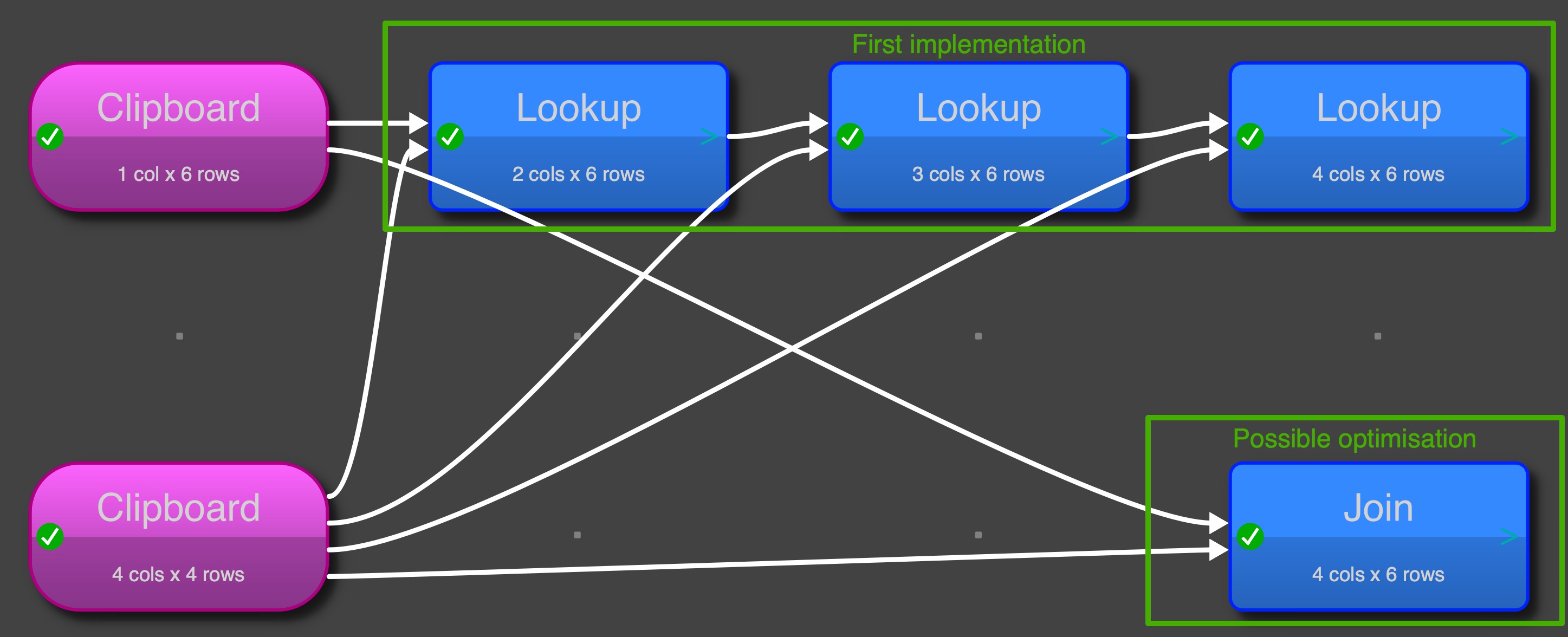
1. Lookup of some Product Master data. There were 3 field in a product master data table which should be enriched. This was implemented first with lookup transformation for each of the 3 fields. Join can be a better choice in such case.
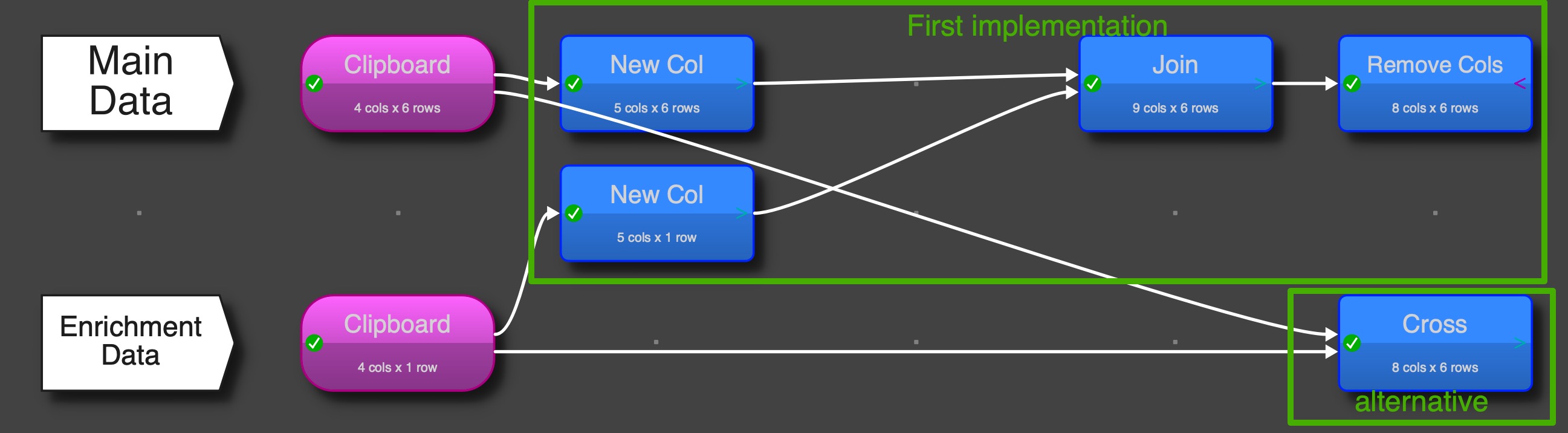
2. Adding additional columns with default values. In the target output need to be some fields with fixed default values. Michail designed a clever solution, with a table with the fields and one row with the default values. When I started with EDT I would have added n “New Col” transformation with the value set. In both tables, the table to be extended and in the table with the new values, a key was generated (new col with value 1) and afterwards the tables were joined on the artificial key and in a further transformation the artificial key was removed. As the table with the data for enrichment includes just one row this can be done with single Cross.
@Michail it was a pleasure. With some of our discussions I checked one of my regular used transformation scripts which I designed more than 2 years ago and I could improve some steps there, too.
It is uncritical in the given case, as the table with the enrichment data has only one row. Otherwise you are totally right.
By, the way join can have unexpected side effects, too. When there is no “lookup value” in the joined table it will change the order of rows in the origin table as the not matched values/rows are moved to the bottom of the table.
No problem with the behaviour, it is just when the sequence is important, lookup is a better choice. I like the current way, as not matching values are at the end (in one place) and can easily analysed without further filtering.