Hello,
I import a large log-file that contains some rows starting with the string ‘CURRENTPHASE’. I’d like to combine all following rows down to the next row starting with ‘CURRENTPHASE’ into one column/field (concat all rows with some delimiter like ‘///’) that I then assign to the row showing ‘CURRENTPHASE’.
Is anyone able to show me how to achieve this?
The text file looks like this:
[…]
CURRENTPHASE MOD_SELROADMAP/SELECT_ROADMAP
…started at 20251023145147
Using phase log file ‘SELROADMAP.LOG’.
…begin dialog at 20251023145148
…end dialog at 20251023145223
…begin dialog at 20251023145223
…end dialog at 20251023145227
…begin dialog at 20251023145227
…end dialog at 20251023145232
…begin dialog at 20251023145232
…end dialog at 20251023145239
Resource usage: self 0.1/ 0.0/15MB usr/sys/mem, children 0.1/ 0.0/50MB usr/sys/mem.
…finished at 20251023145239 with status SUCCEEDED.
CURRENTPHASE MOD_SELROADMAP/CONFCHK_STACK
…started at 20251023145239
Using phase log file ‘CONFCHK_KRNL.LOG’.
Current Operating System (OS) Configuration:
Resource usage: self 0.0/ 0.0/15MB usr/sys/mem, children 0.0/ 0.0/50MB usr/sys/mem.
…finished at 20251023145239 with status SUCCEEDED.
CURRENTPHASE MOD_SELROADMAP/DBCONNCHK_PRE
…started at 20251023145239
Using phase log file ‘PHASE_DBCONNCHK.LOG’.
Resource usage: self 0.0/ 0.0/15MB usr/sys/mem, children 0.0/ 0.0
[…]
Thanks for your help.
Best regards
Alex


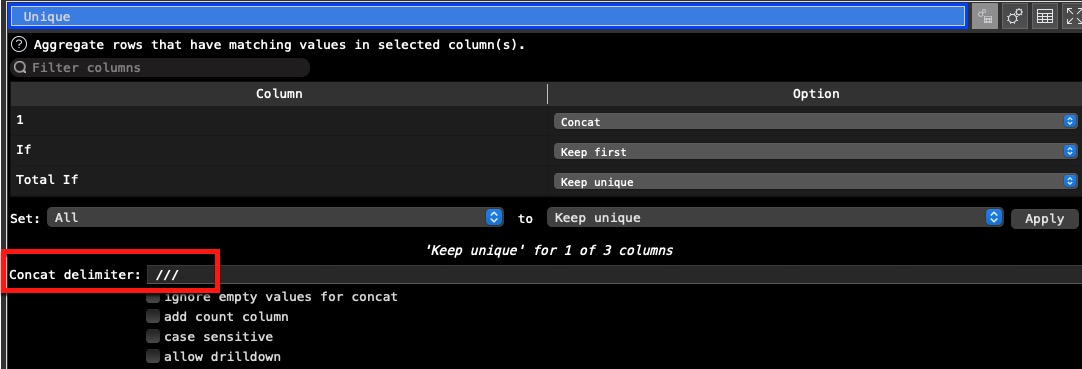
 , evenso I used unique with the concat, but it came not to my mind thinking on the request